Remote ID is the FAA's requirement for drones to broadcast identification and location information during flight. Think of it as a digital license plate for drones. The rule has been in full effect since September 2023 and it applies to nearly every drone operation in the US. Here is what you need to know.
What Remote ID Does
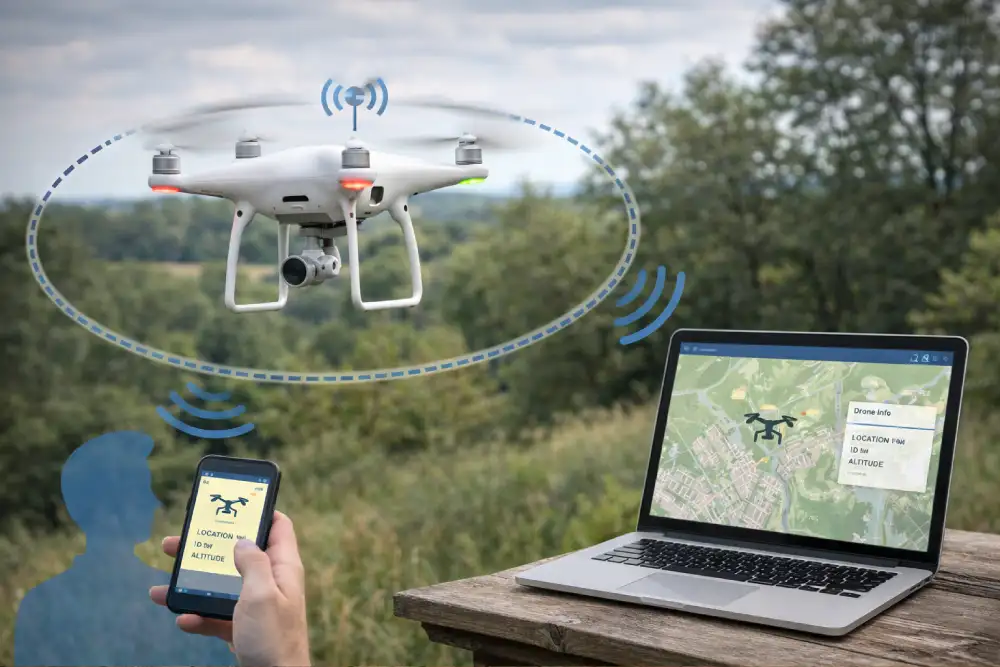
When a Remote ID-equipped drone is flying, it continuously broadcasts a radio signal containing information about the drone and its operator. Anyone nearby with a compatible receiver or app can see that information. The FAA, law enforcement, and other authorized parties can use it to identify drones in flight and locate their operators.
The FAA describes Remote ID as serving the same purpose as an aircraft's registration number — it ties a drone in the air to the person responsible for flying it. This is a key part of the FAA's broader effort to safely integrate drones into the national airspace alongside manned aircraft.
What Information Gets Broadcast
| Data Field | What It Contains |
|---|---|
| UAS ID | A unique identifier for the drone — either its serial number or a session ID generated at takeoff. |
| Drone location | Latitude, longitude, and altitude of the drone. |
| Drone velocity | Speed and direction of travel. |
| Control station location | Latitude, longitude, and altitude of the pilot's ground position. |
| Time mark | A timestamp for each broadcast so the data can be tracked over time. |
| Emergency status | An indicator if the pilot has declared an emergency. |
Notice that the pilot's personal identity — name, address, certificate number — is not in the broadcast itself. The UAS ID links back to FAA registration records, which law enforcement can access. But a random person with a receiver app cannot pull up your name from the broadcast.
The Three Ways to Comply
The FAA allows three methods for meeting the Remote ID requirement:
| Method | How It Works | Who Uses It |
|---|---|---|
| Built-in Remote ID | The drone has Remote ID capability built into the aircraft itself. Most new drones from major manufacturers (DJI, Autel, Skydio) have this. No add-on needed. | Anyone flying a drone manufactured after the rule took effect, or updated models from major brands. |
| Remote ID broadcast module | A small external device attached to the drone that broadcasts Remote ID signals. Used for older drones that do not have built-in capability. | Pilots flying older drones who want to keep using them legally outside of FRIAs. |
| FAA-Recognized Identification Area (FRIA) | A designated area — typically operated by a club or educational institution — where drones without Remote ID can fly legally. The FRIA itself provides the identification boundary. | Hobbyists with older drones flying at approved club fields. |
Who Remote ID Applies To
Remote ID applies to all drones that require FAA registration — meaning any drone weighing more than 0.55 lbs (250 grams). It applies to both Part 107 commercial operations and recreational flying. The only exemption is flying a non-compliant drone within a FRIA.
Drones under 0.55 lbs do not require registration and are not subject to Remote ID. That covers a small number of very lightweight recreational drones but almost nothing in the commercial market.
What Happens If You Do Not Comply
Flying without required Remote ID is a violation of FAA regulations. Penalties can include civil fines and, in cases involving deliberate non-compliance, potential certificate action for Part 107 pilots. The FAA has been actively enforcing Remote ID since the rule took full effect.
Beyond the regulatory risk, flying without Remote ID in an area where law enforcement is investigating a drone incident puts you in a much worse position than a pilot whose drone was broadcasting compliant data the whole time.
Remote ID and BVLOS Operations
Remote ID is also a prerequisite for many advanced operations the FAA is developing pathways for, including beyond visual line of sight (BVLOS) flights. The FAA views Remote ID as foundational infrastructure for the future of drone integration. Pilots who want to access more complex operations down the road will need Remote ID-compliant aircraft regardless.
What the Part 107 Exam Tests
The exam is not going to ask you to configure a Remote ID module. What it tests is whether you understand the concept and the rule. The most common exam questions on this topic:
- What is the purpose of Remote ID? (Broadcast drone and pilot location to identify aircraft in flight)
- What information does Remote ID broadcast? (Drone ID, location, velocity, control station location, timestamp)
- What are the compliance options? (Built-in, broadcast module, or FRIA)
- Does Remote ID broadcast the pilot's personal identity? (No — it broadcasts a UAS ID that links to registration records)
- Which drones are exempt from Remote ID? (Drones under 0.55 lbs that don't require registration, and non-compliant drones operating within a FRIA)
Stay current on the rules before exam day
FAA 107 Prep covers Remote ID, Part 107 regulations, and every other exam topic with practice questions and plain English explanations.