
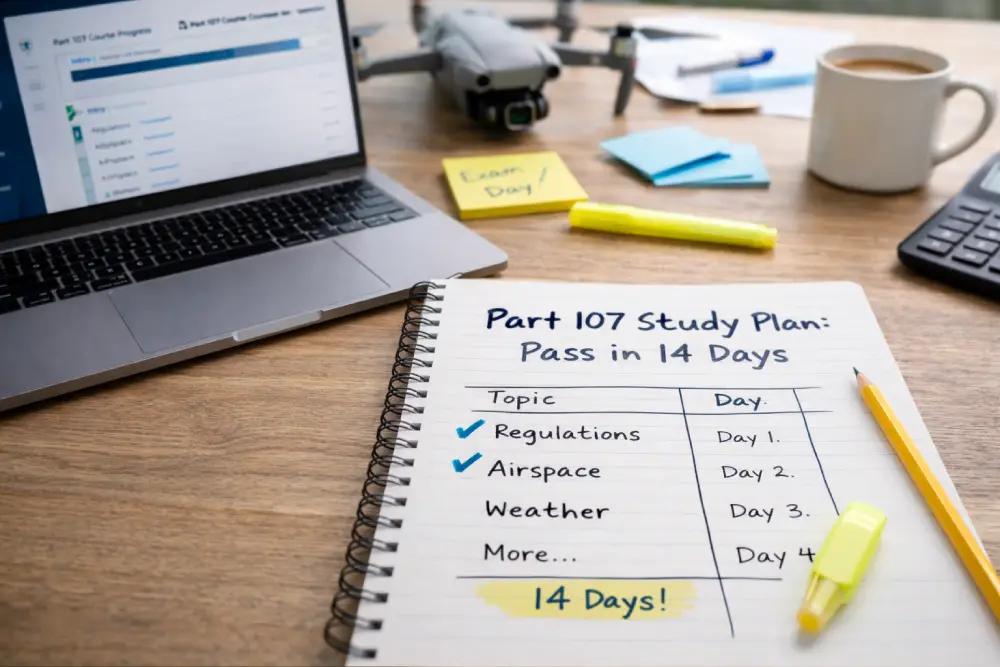
Two weeks is plenty of time to pass the FAA Part 107 exam if you're actually focused. The problem most people run into is spending too much time on the easy stuff and not enough time on the two or three topics that actually trip people up. This plan fixes that.
You're looking at about an hour a day. That's it.
Before Day 1: Schedule Your Test
Do this first. Book your exam at a PSI testing center for 14 days out and pay the $175 fee. Having a real date on the calendar changes how you study. Without it, it's too easy to keep pushing things off.
Days 1 and 2: Learn the Regulations Cold
Start with Part 107 of the FAA regulations. This is the rulebook your license is based on, and a big chunk of the exam is straight-up regulation questions. The good news is these are the most memorizable questions on the test. Learn the altitude limits, BVLOS rules, night flying requirements, Remote ID, and waiver process. Two solid evenings and you'll have most of it down.
Days 3 and 4: Airspace
Class A through G. Know what each one is, who controls it, what the altitude ranges are, and whether you need authorization to fly in it. The FAA Aeronautical Information Manual has a solid breakdown if you want the primary source. Pay special attention to Class B, C, and D since those come up a lot.
Days 5, 6, and 7: Weather
Give weather three days because it deserves it. Start with METARs — learn how to decode them piece by piece. Then move to TAFs, which are basically the same format but for forecasts. Then cover the basics: cloud ceilings, visibility minimums, how wind affects small UAS, and what weather conditions you legally cannot fly in. The NWS Aviation Weather Center is a great place to practice reading real METARs.
Days 8 and 9: Sectional Charts
The exam will show you a piece of an aeronautical chart and ask you questions about it. Practice actually reading them. The FAA publishes current sectional charts for free. Focus on identifying airport symbols, airspace boundaries, the numbers around airports that tell you ceiling and radius, and obstacle markers.
Days 10 and 11: Everything Else
Knock out the remaining topics: radio communications and phonetic alphabet, crew resource management, aircraft loading and performance, and emergency procedures. These sections tend to be lighter on the exam but you don't want to leave easy points on the table.
Days 12 and 13: Practice Tests Only
Stop reading new material. Just take practice tests and review every question you get wrong. This is where the real learning happens. Figure out which topics are still weak and go back to those specifically. Don't waste time re-studying things you already know.
Day 14: Take the Test
Don't cram the morning of. Look over your notes lightly, eat something, and go pass. You've put in the time.
Need practice questions for the plan?
FAA 107 Prep tracks your weak areas automatically so days 12 and 13 are actually useful.