The Mode C Veil is one of those terms that sounds more technical than it is. Once you understand what it is and why it exists, the exam questions about it are straightforward. Here is the plain English version.
What Is Mode C?
Before getting to the veil, it helps to know what Mode C is. Mode C is a transponder mode used by manned aircraft to automatically report their altitude to air traffic control radar. When ATC looks at their radar screen near a busy airport, they can see not just where aircraft are horizontally but also how high they are flying. Mode C is what makes that altitude readout possible.
The FAA requires manned aircraft to have a functioning Mode C transponder when flying in certain airspace — specifically within 30 nautical miles of Class B airports and when flying at or above 10,000 feet MSL. That 30-nautical-mile boundary around a Class B airport is called the Mode C Veil.
What the Mode C Veil Actually Is
The Mode C Veil is an invisible cylinder of airspace centered on every Class B airport, extending 30 nautical miles out from the airport and from the surface up to 10,000 feet MSL. Any manned aircraft flying inside that cylinder must have a functioning altitude-reporting transponder.
It is called a veil because it drapes over the entire area around the airport like a curtain, regardless of which airspace class you are in. You could be in Class G airspace well outside the Class B rings but still inside the Mode C Veil. Manned aircraft in that situation still need their transponder on.
What It Means for Drone Pilots
Here is the part that actually matters for your Part 107 exam and your real-world flying. Drones are not required to have a Mode C transponder. The Mode C Veil is a rule for manned aircraft, not for UAS.
So why does it show up on the Part 107 exam? Two reasons. First, you need to know what it is and be able to identify it when someone mentions it. Second, and more importantly, operating inside the Mode C Veil does not change your drone authorization requirements one bit. Your authorization requirements are determined entirely by the airspace class you are operating in — Class B, C, D, or surface Class E all require authorization regardless of whether you are inside the Mode C Veil. Class G requires no authorization whether you are inside the veil or not.
Mode C Veil vs. Class B Airspace
These two things overlap but they are not the same. Class B airspace has multiple tiers that extend anywhere from 10 to 20 nautical miles from the airport depending on the specific airport. The Mode C Veil extends a full 30 nautical miles. So there is a ring of airspace between the outer edge of Class B and the edge of the Mode C Veil where you are outside Class B but still inside the veil.
| Class B Airspace | Mode C Veil | |
|---|---|---|
| Radius | Varies, typically 10–20 NM | Always 30 NM |
| Shape | Tiered rings (wedding cake) | Simple cylinder, surface to 10,000 ft MSL |
| Applies to drones? | Yes — authorization required | No — manned aircraft only |
| Shown on sectional? | Yes — solid blue lines | Yes — thin blue circle at 30 NM |
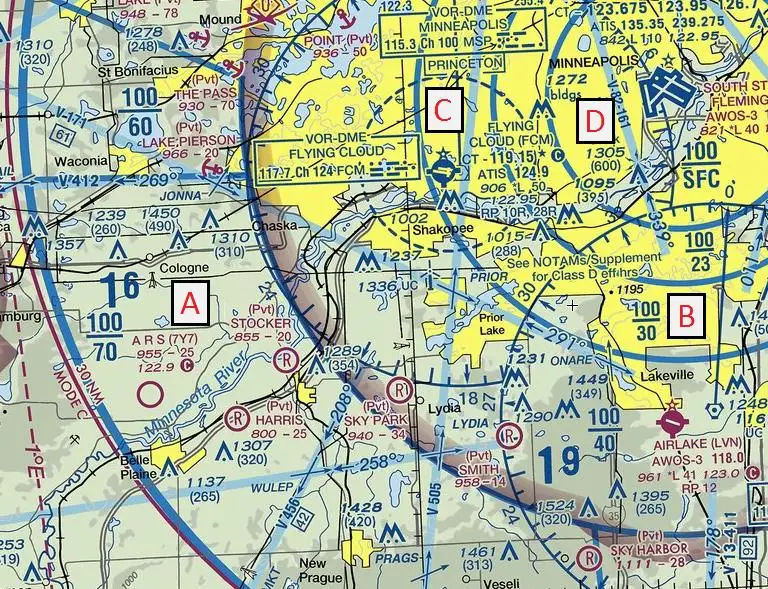
On a sectional chart the Mode C Veil is shown as a thin blue circle at 30 nautical miles from the Class B primary airport. It is easy to confuse with an airspace boundary but it only has meaning for manned aircraft transponder requirements, not for drone authorization.
Quick Summary
| Question | Answer |
|---|---|
| What is the Mode C Veil? | A 30 NM radius cylinder around Class B airports requiring manned aircraft to have altitude-reporting transponders |
| Does it apply to drones? | No — drones are not required to have Mode C transponders |
| Does it change drone authorization requirements? | No — authorization is determined by airspace class only |
| How is it shown on a sectional chart? | Thin blue circle at 30 NM from the Class B primary airport |
Airspace questions are a big chunk of the Part 107 exam
FAA 107 Prep covers the Mode C Veil, airspace classes, authorization requirements, and everything else you need with practice questions and clear explanations.