
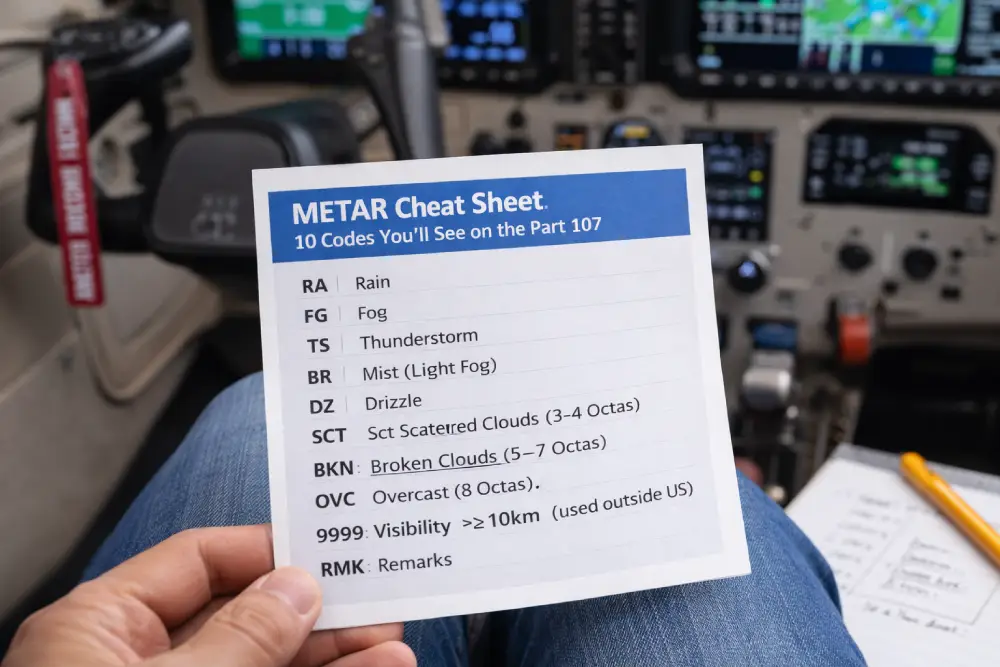
The first time you see a METAR it looks like someone fell asleep on a keyboard. Something like METAR KDEN 261553Z 18012KT 10SM BKN045 OVC090 14/06 A2991 and you're supposed to just... know what that means. The good news is there's a pattern to all of it, and once you see it, you can't unsee it.
Here are the 10 codes that show up most on the FAA Part 107 exam, explained like a normal person would explain them.
The 10 Codes
- METAR — Just tells you the report type. METAR is a routine observation. SPECI means something changed fast enough to warrant a special report. You'll mostly see METAR.
- Station identifier (KDEN, KORD, etc.) — The four-letter code for the airport where the observation was taken. The K at the front means it's in the contiguous US.
- Date/time (261553Z) — The 26 is the day of the month, 1553 is the time in UTC (Zulu), and Z confirms it's Zulu time. Always UTC, never local.
- Wind (18012KT) — First three digits are the direction the wind is coming FROM in degrees. Next two are the speed in knots. So 18012KT means wind from 180 degrees at 12 knots. If you see G, that's gusts: 18012G22KT means gusting to 22.
- Visibility (10SM) — Statute miles. 10SM is 10 miles, which is basically clear. Less than 3SM starts to matter for VFR flying. You need at least 3SM visibility to fly under Part 107.
- Sky condition (BKN045) — Cloud coverage plus height. The number is in hundreds of feet, so BKN045 means broken clouds at 4,500 feet. FEW is 1-2 oktas, SCT is 3-4, BKN is 5-7, OVC is full overcast.
- Temperature and dewpoint (14/06) — Temp first, dewpoint second, both in Celsius. When these two numbers get close together, fog is likely. That's the test-relevant part.
- Altimeter setting (A2991) — Barometric pressure in inches of mercury. A2991 means 29.91 inHg. You'll need this if you're ever talking to ATC, and it shows up in exam questions about pressure altitude.
- TS — Thunderstorm. If you see TS anywhere in a METAR, the answer to "can I fly?" is no.
- BR, FG, RA, SN — Weather phenomena codes. BR is mist, FG is fog, RA is rain, SN is snow. These show up before the sky condition and tell you what's actually happening at the surface.
3 Quick Examples
Example 1: METAR KSFO 141755Z 28014KT 10SM FEW020 18/11 A3002
San Francisco, 1755 Zulu on the 14th. Wind from 280 at 14 knots. 10 miles visibility. A few clouds at 2,000 feet. Temp 18C, dewpoint 11C. Altimeter 30.02. This is a perfectly fine day to fly.
Example 2: METAR KORD 091350Z 09008KT 2SM BR OVC007 07/06 A2988
Chicago, 1350 Zulu. Wind from 090 at 8 knots. Only 2 miles visibility in mist. Overcast at 700 feet. Temp and dewpoint almost identical, so that fog is not going anywhere. You cannot legally fly here. Visibility is below 3SM and ceiling is way below 500 feet.
Example 3: METAR KDFW 201823Z 22018G31KT 7SM TSRA BKN030 OVC060 28/22 A2965
Dallas, winds from 220 gusting to 31 knots. 7 miles visibility. Thunderstorm with rain. That TS means you're grounded, full stop. Doesn't matter that visibility is 7SM.
Want to practice reading METARs with real questions?
FAA 107 Prep has weather questions with full explanations so this stuff actually sticks before exam day.