
People hear "FAA test" and picture the written exam for a pilot's license — a monster of a thing that takes months to prepare for. The Part 107 test is not that. But it's also not something you can walk into cold and wing. The honest answer to "how hard is it?" is: medium, with a few legitimately tricky spots.
Here's exactly what you're walking into.
The Basics: What the Test Looks Like
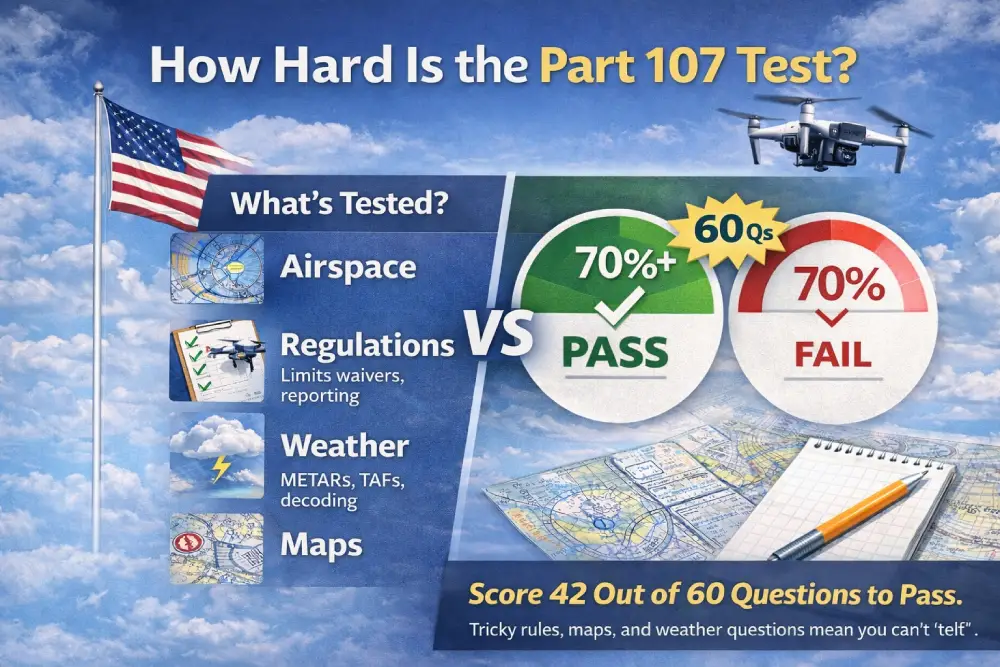
The FAA Part 107 knowledge test is 60 multiple-choice questions. You have 2 hours to finish. You need a 70% to pass — that's 42 out of 60 questions correct. You take it in person at an FAA-approved testing center (PSI or CATS locations), and it costs $175.
There's no flight test. No oral exam. Just you, a computer, and 60 questions.
What's Actually on the Test
The FAA publishes the official test topic areas, so there are no real surprises. The main categories are:
- Airspace classification — Class A through G, what's controlled, what's not, and where you can and can't fly
- Weather interpretation — reading METARs, TAFs, understanding cloud ceilings, visibility, and how weather affects flight
- Sectional charts — reading aeronautical charts to find airports, airspace boundaries, and obstacles
- Part 107 regulations — the actual rules: altitude limits, BVLOS, night flying, waivers, remote ID
- Radio communications — basic phonetic alphabet, how to communicate with ATC if needed
- Emergency procedures and crew resource management — what to do when things go sideways
- Aircraft loading and performance — how weight and conditions affect your drone
What a 70% Actually Means
You can miss 18 questions and still pass. That sounds like a lot of wiggle room, but here's the thing — those 18 questions go fast if you're unprepared on weather or charts. It's very easy to get wiped out on a single topic category.
Think of it this way: if you completely blank on METARs and sectional charts, you could easily drop 10–12 points right there before you've even touched the other categories. That leaves you almost no margin for anything else.
The people who fail usually don't fail because the whole test is hard — they fail because one or two categories absolutely wrecked them.
The Two Areas That Trip People Up Most
Weather reading is the big one. METARs look like gibberish the first time you see them. Something like METAR KORD 241553Z 27015KT 10SM FEW045 BKN250 22/14 A2992 — if you haven't practiced decoding that, you're going to stare at it for a while. The good news is it's totally learnable once someone walks you through the format.
Sectional charts are the other one. The FAA will show you a section of an aeronautical chart and ask questions about it — what kind of airspace are you in, what's the ceiling, is there an airport nearby, what do those little symbols mean. It's visual and spatial in a way that feels different from the other questions. Practice makes a huge difference here.
For a deeper dive on weather specifically, the NWS Aviation Weather Center is a solid resource to get familiar with real METARs and TAFs.
How Long Does It Take to Prepare?
Most people who pass on the first try study for somewhere between 10 and 20 hours total. If you already have a background in aviation or meteorology, you might need less. If terms like "Class D airspace" and "altimeter setting" are totally new to you, budget closer to 20 hours and make sure you're actually drilling practice questions — not just reading.
Passive studying (just reading the material) doesn't work nearly as well as active recall. Take practice tests. Get things wrong. Figure out why. That's what moves the needle.
Want to drill the hard stuff first?
FAA 107 Prep focuses your practice on weak areas — so you spend time on what actually matters and walk into test day confident.