
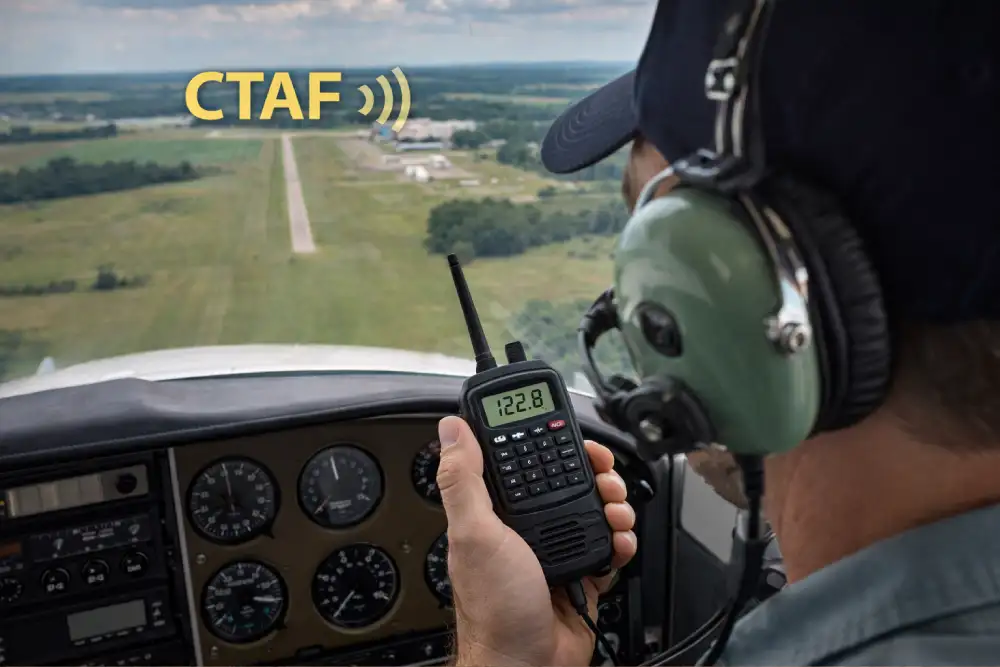
CTAF stands for Common Traffic Advisory Frequency. It is a radio frequency that pilots use to communicate their position and intentions around airports that do not have an operating control tower. You will see it on sectional charts and it comes up on the Part 107 exam. Here is everything you need to know.
The Problem CTAF Solves
At a towered airport, ATC handles traffic separation. Pilots talk to the tower, the tower tells them when to take off, land, and where to fly in the pattern. Everyone knows where everyone else is because there is a controller coordinating it all.
At an airport without a control tower — and there are thousands of them across the US — there is no controller. Pilots have to coordinate with each other directly. CTAF is how they do it. Every pilot approaching or departing that airport broadcasts their position on the CTAF frequency so other pilots in the area know they are there. It is a self-announce system.
Where You See CTAF on a Sectional Chart
On a sectional chart, the CTAF frequency is printed next to the airport name in magenta text, preceded by a circled C symbol. It looks something like Ⓒ122.8. That number is the radio frequency in MHz that pilots use to communicate at that airport.
At some airports the CTAF frequency is the same as the UNICOM frequency, which is a general-purpose air-to-ground communication frequency at non-towered airports. When that is the case you might see it listed as CTAF/UNICOM on airport information.
What CTAF Means for Drone Pilots
Drone pilots are not required to have a radio or to broadcast on CTAF. Part 107 does not include any radio communication requirements for UAS operators. So in a strict regulatory sense, CTAF does not apply to you.
That said, understanding CTAF matters for two reasons. First, the Part 107 exam will test whether you know what it is and where it appears on a sectional chart. Second, as a practical matter, knowing that manned aircraft near non-towered airports are communicating on CTAF helps you understand the traffic environment you are operating in. If you are flying near a non-towered airport, manned aircraft are in the pattern and talking to each other on a frequency you cannot hear.
CTAF vs. ATIS vs. UNICOM
These three terms get mixed up on the exam. Here is how they differ:
| Term | What It Is | Where It's Used |
|---|---|---|
| CTAF | Common Traffic Advisory Frequency. Pilots self-announce position and intentions. | Non-towered airports. Sometimes used at towered airports when the tower is closed. |
| UNICOM | A private air-to-ground radio frequency for non-ATC communications — fuel requests, airport info, etc. Often the same frequency as CTAF at non-towered airports. | Non-towered airports primarily. |
| ATIS | Automatic Terminal Information Service. A pre-recorded broadcast of current weather, active runway, and NOTAMs at busier airports. Updated hourly or when conditions change significantly. | Towered airports — Class B, C, and some D airports. |
Towered vs. Non-Towered Airports: A Quick Comparison
| Towered Airport | Non-Towered Airport | |
|---|---|---|
| ATC present? | Yes, during operating hours | No |
| Traffic coordination | Controlled by ATC | Pilots self-announce on CTAF |
| Sectional symbol color | Blue | Magenta |
| Airspace class | Usually Class C or D | Usually Class E or G (check for dashed magenta ring) |
| Drone authorization needed? | Yes — Class C or D requires it | Depends — check airspace class at that location |
| Radio required for drones? | No | No |
What the Exam Actually Tests
The exam is not going to ask you to transmit on CTAF or know the specific frequency for a given airport. What it does test:
- What CTAF stands for and what it is used for
- Where CTAF is used — non-towered airports, and towered airports when the tower is closed
- How CTAF is indicated on a sectional chart — the circled C symbol followed by the frequency
- The difference between CTAF, UNICOM, and ATIS
- Understanding that non-towered airports still have manned aircraft traffic even without ATC
Ready to test your airspace knowledge?
FAA 107 Prep covers CTAF, airspace classes, sectional charts, and every other exam topic with practice questions and plain English explanations.