Airspace classification is one of those things that sounds more complicated than it is. Six classes, a bunch of rules, and a sectional chart covered in circles and numbers. But there is actually a simple way to think about all of it, and once it clicks, the exam questions get a lot easier.
The Mental Model: How Busy Is the Airport?
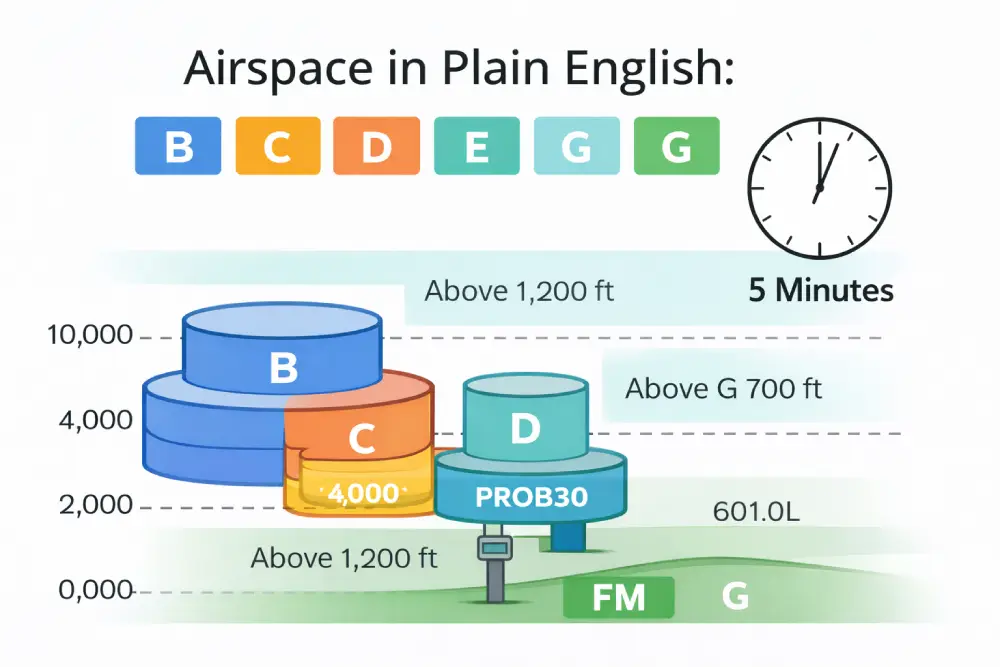
Think of airspace classes as the FAA's way of saying how much traffic control an area needs. The busier and more complex the airport, the more controlled the airspace around it. That's basically it.
- Class B is the big stuff. Major commercial airports like LAX, JFK, O'Hare. Lots of airline traffic, radar coverage, and you need authorization to fly a drone in it. It looks like an upside-down wedding cake on a sectional chart, with layers that get wider as you go up.
- Class C is mid-size airports. Think regional airports with a control tower and radar. Still controlled, still needs authorization for drones, but smaller footprint than Class B.
- Class D is smaller airports that have a control tower but no radar. Tighter radius, lower ceiling. Also needs authorization for drone ops.
- Class E is controlled airspace that doesn't fit neatly around a specific airport. It covers a lot of the airspace you fly through without thinking about it. The floor varies and that matters for drones.
- Class G is uncontrolled airspace. No ATC involvement. Generally the airspace close to the ground in rural areas. Most drone flying under 400 feet in open areas is happening in Class G.
So the quick version: B, C, D all need authorization. G is generally fine. E depends on where the floor is.
Gotcha 1: Class E Goes Down to the Surface Too
Most Class E airspace starts at 1,200 feet AGL, which means a drone flying at 400 feet is in Class G underneath it. No authorization needed. But around some airports, Class E extends all the way down to the surface. When that happens it shows up on a sectional chart as a dashed magenta circle, and you do need authorization to fly there.
A lot of people assume Class E is always fine because it's not B, C, or D. That assumption will get a question wrong. Always check where the floor is.
Gotcha 2: Class A Does Not Come Up for Drones
Class A is everything from 18,000 feet up to 60,000 feet. You are not flying a drone there. The exam might mention it but you will never need to worry about it operationally. Don't spend time on Class A. Save that brain space for Class E.
How to Get Authorization When You Need It
The FAA runs a system called LAANC that handles drone authorizations automatically for most controlled airspace. You request it through an approved app, it checks your altitude against the FAA's grid, and you get a yes or no in seconds. It's genuinely not a hassle for most flights. The exam will not go deep on LAANC mechanics but knowing it exists is worth it.
Airspace questions on the exam are very learnable
FAA 107 Prep drills airspace classification with explanations that actually make the rules stick.